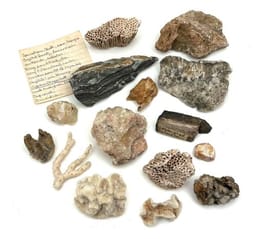
The Book of Unconformities by Hugh Raffles
$22.95
Conglomerate rock is easy to identify—it is a sedimentary rock made of up little pebbles, usually rounded though sometimes not, bound together by naturally-forming cement. It turns up on the beaches of Lake Erie, and I have a particularly nice piece—heavy and rounded, with a pleasing variety of cloudy grays and quartz glimmers—sitting on my desk.
Reading Hugh Raffles mesmeric book about rocks—The Book of Unconformities: Speculations on Lost Time—I got to thinking about how a book can be like a rock. As Raffles explains it, an unconformity, geologically speaking, is "discontinuity in the deposition of sediment." It is a visible mineral rupture in the expected geological timeline created by eruptions, collisions, or tectonic shifts—"a material sign of a break in time." Raffles describes them as "both a seam and a rupture."
A great book is an unconformity, too, a manifestation of mind that somehow takes the material surrounding us and pressures it into something else–maybe new, maybe not, but something with its own integrity that stands apart, a demarcation. And one of the greatest pleasures I find in reading is an encounter with this sense of completeness, of something (mind? thought?) fully manifest, which maybe sounds woo-woo, but reading my favorite books has a feeling I sometimes find akin to a weathered rock in the hand, whole and heavy and complete.
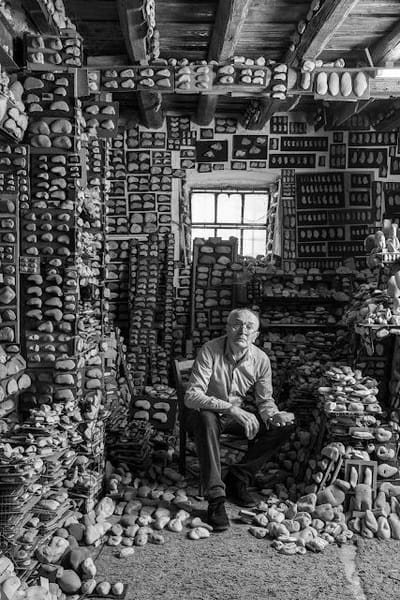
Anyway, as I read this book, which is organized into a series of grief-sparked encounters with rocks and minerals—marble, sandstone, gneiss, magnetite, blubberstone, iron, and muscovite—excavating the intricately connected mysteries, histories, and tragedies in northern landscapes where they are found, I was distracted by recognitions—of the trace fossils of W.G. Sebald in the long twisty sentences Raffles stacks with facts like cairns marking the path of thought; the grainy black-and-white photos that punctuate the text; the culmination in a story about the Holocaust. But Barry Lopez is here, too, in the careful attentiveness to landscapes, particularly Arctic landscapes, and the patient untwining of the multiplicity of experiences that have happened as white people moved into Indigenous places, of traumas to the land, animals, and people, and in curiosity-sparking footnotes that point to whole other books-worth of detail. These two writers shadowed my reading, making me wonder if Raffles could make their signature patterns somehow his own. In the end, he didn't, quite—the effect was conglomerate, a sort of pleasing agglomeration.
7 months ago
Comments

Follow even*cleveland
By submitting, you agree to our Terms and Privacy Policy