Honey from a Weed: Fasting and Feasting in Tuscany, Catalonia, The Cyclades and Apulia (paperback)
$40
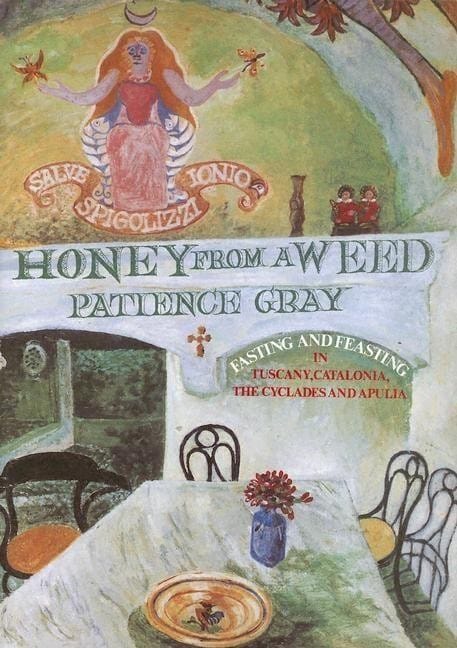
Transporting, mesmeric, fabulous, and maddening. In her forties, the English-born Gray upended her comfortable life as a successful cookbook author to follow the sculptor Bernard Mommens to the Mediterranean. In his quest for stone, they lived in remote areas of Greece, Italy, and Spain, and Gray committed herself to rural life, absorbing and recording a dizzying array of local culinary folkways. The book, published in the mid 1980s, is absolutely singular—reminisces of seasonal feasts and meetings with rare book collectors sandwich a chapter on anarchy—and crammed with a plethora of extremely specific, plainspoken recipes that range from the simple to the terrifyingly time-intensive. (One that requires poking the seeds out of grapes with a pin haunts me.) Gray's unsentimental admiration for the resourcefulness of the communities she lives in is obvious, and yet much of what she admires is a reality shaped by brutality—foraging less as a delightful diversion and more as a desperate need to make as many things as possible palatable.
Print out Angela Carter's 1987 LRB review, which digs into the uneasy question of Gray's privilege, as a side dish:
"The metaphysics of authenticity are a dangerous area. When Mrs Gray opines, ‘Poverty rather than wealth gives the good things of life their true significance,’ it is tempting to suggest it is other people’s poverty, always a source of the picturesque, that does that. Even if Mrs Gray and her companion live in exactly the same circumstances as their neighbours in the Greek islands or Southern Italy, and have just as little ready money, their relation to their circumstances is the result of the greatest of all luxuries, aesthetic choice."
Offer Pulp's "Common People" as an apéritif
5 months ago
Comments


Follow even*cleveland
By submitting, you agree to our Terms and Privacy Policy